Guess what?
I overthink things.
I know… you’re shocked.
If you read my post about Why The Young Napoleon Project then you know I share a trait with General George B. McClellan: we were both overthinkers and overplanners.
My anxiety?
Well… that doesn’t exactly help either.
I can get lost overthinking the smallest things.
Did I say the wrong thing?
Should I have sent that text?
Did I make the right decision?
Then I can spend hours thinking about everything that might be waiting for me tomorrow.
I imagine I’m not alone.
Like so many people, I tend to obsess over tiny moments that probably don’t mean nearly as much as I convince myself they do.
You know what’s sad, though?
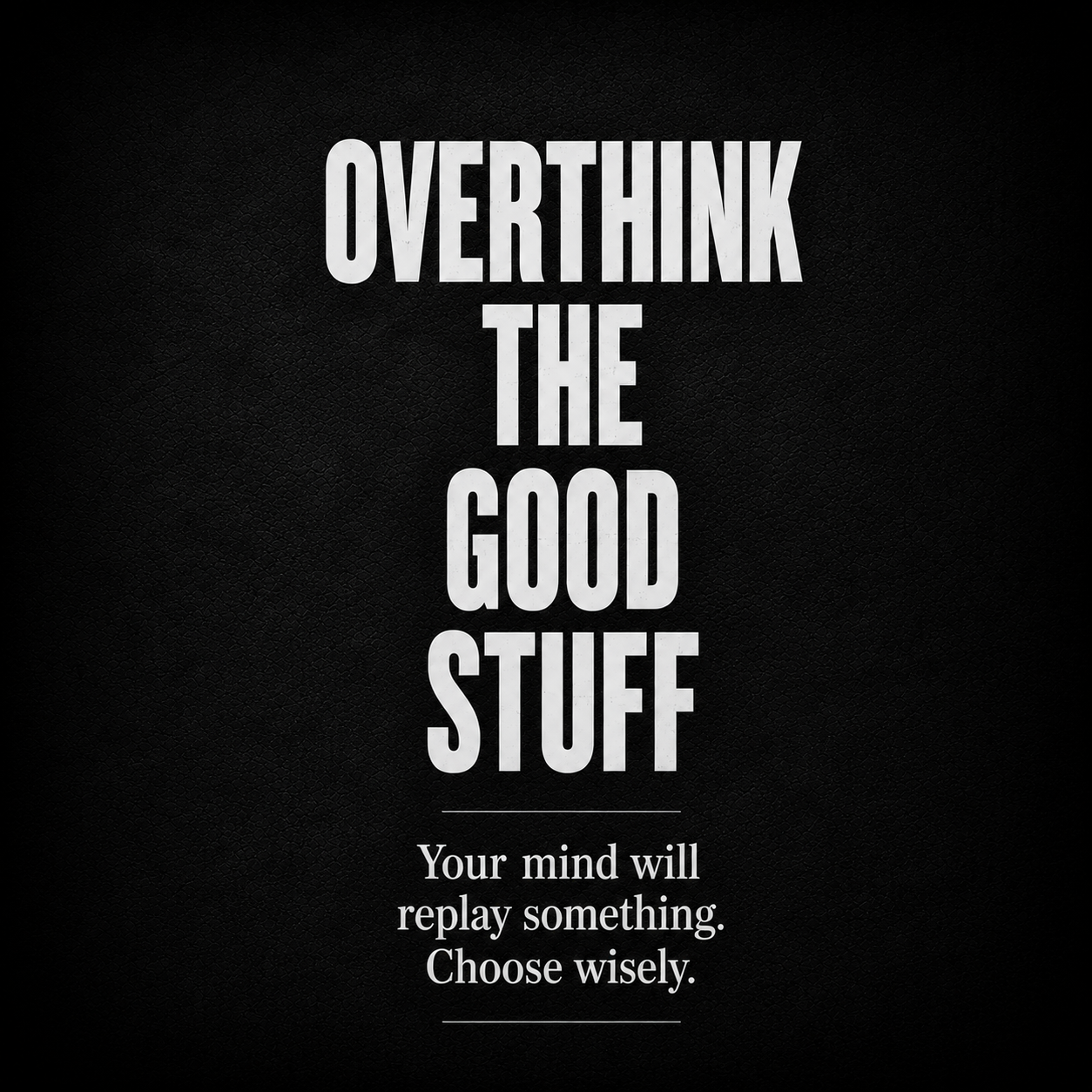
We rarely overthink the good stuff.
I don’t have Brooks’ and Joseph’s laughter replaying on a loop in my head.
I don’t constantly revisit the quiet moments Jillian and I share together.
I don’t spend hours remembering the funny things Joseph says or the way he says them.
Those moments come into my life…
And then they’re gone.
Meanwhile, anxiety, fear, and worry seem to live in my head rent-free.
Some of that is chemistry.
Some of it is simply the way our brains are wired.
While researching this, I came across an article in Psychology Today explaining why our brains naturally gravitate toward negative thinking. It pointed out that our minds are wired to pay more attention to potential threats than positive experiences—a survival instinct that made a lot of sense thousands of years ago, but one that can easily leave us replaying our worst moments while overlooking our best ones.
Our minds are trying to protect us.
They’re scanning for danger.
Preparing us for tomorrow’s meeting.
The unexpected bill.
The difficult conversation.
Sometimes they’re trying to teach us something.
“Remember that mistake you made yesterday? Think about it for the next three hours so you never make it again.”
And honestly…
There’s some value in that.
We should learn from our mistakes.
We should approach unfamiliar situations with healthy caution.
Sometimes there really is a good reason to worry about something on tomorrow’s calendar.
But left unchecked, our minds can convince us that our worst moments deserve the most attention.
What if we trained our minds a little differently?
What if we intentionally spent time replaying the good moments instead?
Not to ignore our problems.
Not to pretend life is perfect.
But because those moments deserve our attention too.
In my reading, I came across another article from Verywell Mind about learning to savor positive moments. One of the things that stood out to me was the reminder that joy often doesn’t require bigger experiences—it requires paying closer attention to the ones we’re already having. The more intentional we are about noticing and lingering in those moments, the more likely we are to remember them later.
They deserve to be appreciated.
They deserve to be remembered.
What if you spent just five minutes every day thinking about your kids laughing?
The love you share with your spouse.
Good news you recently received.
The ordinary moments when, for just a little while, nothing was wrong.
What would happen?
Would your outlook change?
Would you feel a little lighter?
Would your day be just a little better?
I think it might.
The moments we replay become the stories we tell ourselves about our lives.
If we come home from work and only replay everything that frustrated us, how can we expect the rest of our evening not to be colored by that frustration? It’s also why I wrote Don’t Let Your Storm Get Your Kids Wet. The stories we replay don’t always stay inside our own heads—they often shape how we show up for the people we love.
If we replay only our failures, eventually we’ll begin believing we’re failures.
If we spend all night overthinking tomorrow’s problems, we’ll wake up already convinced it’s going to be a bad day.
And in doing so, we’ll miss the moments that could have made it a good one.
But what if we intentionally replayed moments of joy instead?
What if we celebrated the small wins?
What if we got excited about what still lies ahead?
What if we filled our minds with the memories that remind us life is good, even when it isn’t perfect?
When I look back on this project, I realize I’ve spent a lot of time writing about ordinary moments instead of extraordinary ones. It’s something I’ve explored before in Why Ordinary Days Matter More Than Big Moments. The memories that shape our lives usually aren’t the spectacular ones—they’re the ordinary moments we almost overlook.
Walks around the neighborhood.
Playing catch.
Reading bedtime stories.
Quiet evenings with Jillian.
Those moments are my life.
Some days are harder than others.
Some stories are painful.
But if I only focused on those moments, I’d completely miss the ones that make this life so beautiful.
So yes…
Tomorrow I’ll probably wake up and still be an overthinker.
That isn’t changing overnight.
I’m forty-one years old.
If it were that easy, it probably would have happened by now.
I’ll probably replay some small mistake I made today.
I’ll probably worry about something waiting for me tomorrow.
But I’m also going to try to be more intentional about replaying the good stuff.
The laughter.
The walks with my boys.
The quiet moments with Jillian.
The conversations I’ll someday wish I could have one more time.
Because those moments are the best part of my life.
And if I’m going to overthink anything…
I’d rather it be the good stuff.
Continue the Journey:
- Why The Young Napoleon Project — The story behind the name and the philosophy that inspired this journey.
- Don’t Let Your Storm Get Your Kids Wet — How the thoughts we carry can shape the way we show up for the people we love.
- Why Ordinary Days Matter More Than Big Moments — Why the moments we almost overlook often become the ones we treasure most.
Further Reading:
Psychology Today — “3 Reasons Why Your Brain Loves Negative Thinking”
Verywell Mind — “How to Savor the Moment”
https://www.verywellmind.com/how-to-savor-the-moment-3144633


