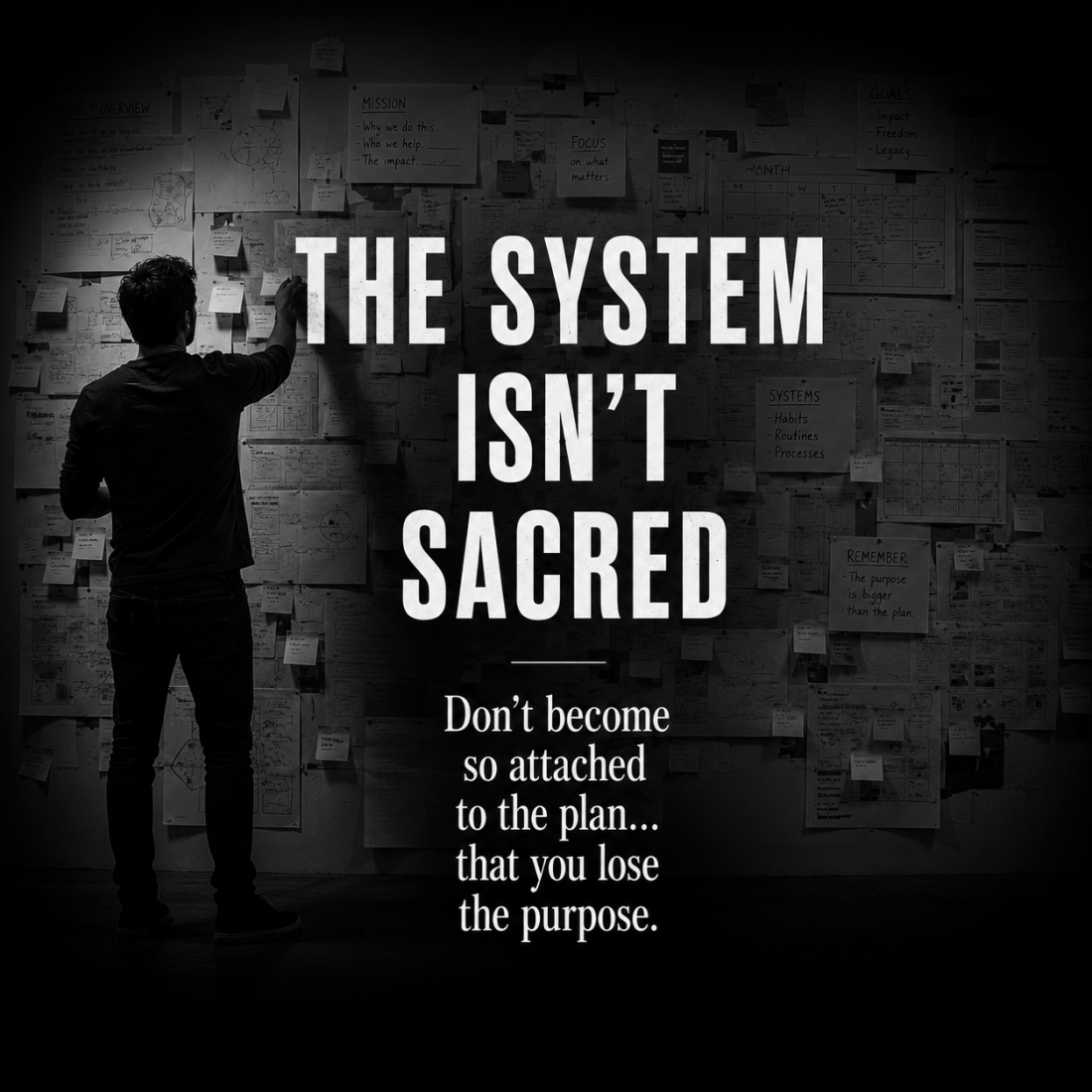

The System Isn’t Sacred

Yesterday I had to admit something I didn’t want to.

The Young Napoleon Project wasn’t going to become the project I had spent the last ten years imagining.

That was surprisingly hard to accept.

Not because the project was failing.

But because the picture I had carried in my head for a decade wasn’t real anymore.

For years I had envisioned every detail of this project. I had planned the action tracking, the scoreboards, the data collection, the documentation, and even redundancies for the redundancies because I wanted to capture everything. I wanted complete control over the process.

Then I finally launched the project.

And after six weeks of actually living it, I realized something I never could have learned while planning it.

It was too much.

Not because I wasn’t willing to work hard.

Because I had built a system that demanded so much attention that it was beginning to compete with the very life it was supposed to support.

Somewhere along the way, I realized I was spending so much time documenting the project…

that I wasn’t actually living it.

So I started removing things.

I eliminated redundant tracking.

I simplified my systems.

I stopped documenting the same information in multiple places.

Not because those things were bad ideas.

Because they were getting in the way of the things that mattered most.

They were taking time away from my writing.

They were taking time away from the fitness goals I had allowed to slip.

They were taking time away from being present with my family.

Making those changes should have been easy.

Instead, it felt like I was giving something up.

The strange thing about plans is that after we’ve lived with them long enough, they stop feeling like plans.

They start feeling like promises.

We convince ourselves that success isn’t simply reaching the destination.

Success becomes following the exact route we imagined.

That’s where we get ourselves into trouble.

We become so committed to the process that we forget why we created it in the first place.

Businesses can’t cling to outdated processes simply because they’re familiar.

Parents constantly adjust routines as their children grow.

Travel plans change.

Careers change.

Life changes.

The people who continue moving forward aren’t the ones who never change their plans.

They’re the ones willing to change them when reality demands it.

For a while, I thought abandoning parts of my original plan meant admitting I had been wrong.

Now I think the opposite.

Those ten years weren’t wasted.

They gave me the vision.

But once the project became real, reality became a better teacher than imagination.

The system was never the project.

The scoreboards weren’t the project.

The trackers weren’t the project.

The spreadsheets weren’t the project.

Those things were simply tools meant to help me become the person I wanted to become.

And when the tools stopped serving that purpose…

They needed to change.

Six weeks ago I started this project with what I believed was the perfect blueprint.

Less than two months later, much of that blueprint no longer exists.

The dream does.

I chose the project over the systems.

I chose writing over documenting.

I chose to make room for my health instead of protecting routines that were no longer helping me.

For ten years I thought protecting the blueprint meant protecting the dream.

I finally realized they aren’t the same thing.

The blueprint can change.

The dream doesn’t have to.

Continue the Journey:

If you enjoyed this article, you may also like:

A Life, Not a Collection of Parts

It’s easy to divide life into separate categories—work, family, health, hobbies—but the most fulfilling life isn’t built by keeping those pieces apart. It’s built by learning how they fit together.

I Finally Stopped Waiting to Feel Motivated

Waiting for motivation kept me standing still for years. Progress finally began when I stopped chasing the perfect feeling and simply started doing the work.

The Coach Can’t Do the Work

The right tools, the right systems, and the right coach can all help you move forward. But in the end, no one else can do the work that only you can do.

The Coach Can’t Do The Work

I am going to be starting a personal training program in the next week or so, and yesterday I had my first call with my trainer. Being honest, I was nervous. I had never worked with a personal trainer before, but the conversation was great and also a little unexpected. Instead of just talking about exercises and nutrition, we talked about my goals, the habits I want to build, the mental aspect of getting healthier, my history with weight, and what I hope to achieve in the future.

As exciting as the call was, and as motivated as I am to work with this trainer, I’m still the one who has to put in the work. That’s something I’ve struggled with my whole life when it comes to my health.

The trainer can write my workouts, answer my questions, help keep me accountable, and encourage me when I’m frustrated. But he can’t lift the weights for me. He can’t choose what I eat every day. He can’t walk the steps I need to walk. He can’t say no to the junk food or turn off the TV so I can go work out. He can be a guide, but I still have to choose to follow.

I’ve done it before. In what feels like a past life, I lost 170 pounds. I was determined. I was resilient. Then I wasn’t. Some of the weight came back, and with it came frustration and disappointment.

Since then, I’ve read books about motivation and discipline. I’ve listened to podcasts. I’ve watched countless videos. I know what it takes to get back to where I want to be.

Information has never been the problem.

Turning that information into action has.

Often we think success comes from the tools we use along the way. The right pen or computer will help us write more. The right planner will keep us organized. The right app will keep us on task. Maybe the right coach will finally help us reach our goals.

Those things absolutely help.

They make the path clearer.

But they can’t walk it for us.

This project has never been about finally discovering the secret that erased years of failure. There isn’t one.

The progress I’ve made has come from doing the work day after day. From refusing to quit when things got hard. From not accepting defeat when I fell behind. From allowing the process to evolve instead of abandoning it because I was too stubborn to change.

The tools I’ve chosen have helped me get this far, but they aren’t the reason I’m here.

This trainer will be no different.

He gets to be on my team. He gets to challenge me, encourage me, and help me decide what I need to do to reach my goals.

But I still have to do the work.

The tools you use can help you write. They can help you stay organized. They can help you stay on task.

But if you don’t do the work, the tools can’t do it for you.

A coach, a trainer, or an accountability partner can all cheer you on. They can believe in you, even on the days you don’t believe in yourself.

But when it’s time to do the work…

You’re the one who has to do it.

And when you do, you’ll have something no one can ever take away from you:

The satisfaction of knowing you earned it.

Continue the Journey:

If you enjoyed this article, you may also like:

  • I Finally Stopped Waiting to Feel Motivated
    Motivation may get you started, but lasting change comes from taking action even when you don’t feel like it.
  • Stay in the Game
    Progress belongs to those who refuse to quit. Once you’ve committed to the journey, the work still has to be done one day at a time.
  • Every Opportunity Begins With Risk
    Hiring a coach, starting a new program, or chasing a goal all begin with uncertainty. The next step is doing the work that turns opportunity into progress.

Stay In The Game

Last night was poker night with the Papa Pandas. Ten of us showed up for a Texas Hold ‘Em tournament. On the opening hand I made two pair and won a large pot. Then I didn’t win another hand for a very long time.

Eventually the table had dwindled down to four players, and my dwindling stack was the smallest of them all. If you had taken a poll around the table, I probably wouldn’t have been the favorite to come out on top.

But I stayed patient. I played my game, bet when I thought the odds were in my favor, and took it one hand at a time. I eliminated one player, then another, and eventually it was just me and the chip leader. I won a couple of smaller pots to even things up before catching an outside straight on the river and moving all in. He called with two pair, and I walked away the winner.

I didn’t win because I played every hand perfectly. I folded hands that would have become winners and played a few that I probably shouldn’t have. I won because I stayed patient and stayed in the game. The cards certainly helped, but they couldn’t have helped me if I had already given up.

It made me wonder about all the other things I’ve quit simply because I got behind. How many times have I stopped writing because the words wouldn’t come? Quit exercising because the scale didn’t move? Walked away from a sport because I wasn’t getting playing time? Given up because things simply became too hard? Not because I was destined to fail, but because success didn’t seem likely, and I mistook where I was for where I was going to finish.

Yesterday I wrote that seizing opportunity requires us to accept uncertainty before we can enjoy the reward. Today I’m realizing that’s only half the story.

Sometimes taking the risk isn’t enough. Sometimes the reward only comes because we stay around long enough for it to arrive.

If you quit trying to lose weight every time the scale goes up or refuses to move, you’ll never reach your goal.

If you abandon every project because the results aren’t immediate, you’ll never finish anything meaningful.

If you give up on every dream because reality doesn’t match the picture in your head, you’ll never become the person you hoped to be.

It won’t be because you weren’t talented enough or capable of working hard enough. It’ll be because you didn’t give yourself—or your dream—the time it needed.

Last night I happened to win the poker tournament. But that’s not what I’ll remember.

I’ll remember looking down at the smallest stack at the table and realizing that as long as I still had chips in front of me, the story wasn’t over.

Sometimes the only thing you can do is stay in the game long enough to find out how the story ends.

Continue the Journey:

If you enjoyed this article, you may also like:

Every Opportunity Begins With Risk

This week I took a risk and put myself out there. I saw an opportunity worth pursuing, and despite my nervousness and anxiety, I sent the message. I asked the question, and I was rewarded for taking that chance. It wasn’t luck. It was action in the face of uncertainty.

We’ve all faced uncomfortable moments. Moments where something worth having sat directly across from our own insecurities and doubts. We imagine being ignored, turned down, or told no. We worry that we’re imposing on someone else or putting them in an uncomfortable position. In those moments, the opportunity may exist, but it isn’t real because we haven’t yet made the decision to pursue it.

Then comes the decision. You put yourself out there. You make yourself vulnerable. You expose yourself to rejection or awkwardness. Sometimes you’re rewarded with acceptance, and afterward you wonder why you waited so long. It wasn’t nearly as big of a deal as you had made it out to be. Then another thought creeps in: how many other opportunities have you missed simply because you weren’t willing to accept a few moments of discomfort while waiting to see what might happen?

I think about my kids. They don’t see the risk; they only see the reward. When Brooks walked into his first karate class, he didn’t know if he would like it. He was nervous. He didn’t know anyone. But if he had never walked through those doors, he never would have discovered something he genuinely enjoys. Children are often willing to try first and worry later. As I wrote in Brooks’s First Tae Kwon Do Class, the hardest part wasn’t earning the belt—it was walking through the door for the very first time. As we get older—even by the time we’re Brooks’ age—that begins to change. Doubt slowly creeps in. Our confidence starts giving way to thoughts about what other people might think if we fail or embarrass ourselves. The older we get and the more rejection we experience, the easier it becomes to focus on the opportunities we’ve missed instead of the ones we’ve seized.

As I thought about it, I realized how many of the best parts of my life began with accepting that same risk. Going back to school for my bachelor’s degree, and later my master’s, while working full-time and starting a family. Coaching Brooks’ baseball team. Walking into my first Papa Pandas meeting. Starting this blog one more time after nearly a decade of false starts. None of those moments felt comfortable beforehand. Every one of them was worth it afterward.

Every opportunity asks us to take a risk before we can enjoy the reward. The hardest part isn’t saying yes to the opportunity—it’s saying yes to the uncertainty that comes before it. As I shared in I Finally Stopped Waiting to Feel Motivated, waiting until we feel ready often means waiting forever. Growth rarely begins with confidence; it begins with the decision to act anyway.

Looking back, I’m far more grateful for the opportunities I experienced because I was willing to accept the risk than I am bothered by the times I was rejected. Because you can’t reap the reward without first accepting the risk.

Continue the Journey:

If you enjoyed this article, you may also like:

A Masterpiece And A Work In Progress

It feels like just yesterday that we brought Brooks home from the hospital. It was the beginning of the pandemic, and for weeks it was just Jillian, me, and this tiny little boy sitting in our living room trying to figure out how to be parents. We had no idea what we were doing.

That was more than six years ago.

Today I took Brooks up to the fields for hitting practice as he prepares for his first season of Rookies in Little League. At the same time, Joseph took his first swimming lesson in the next level class. Somewhere along the way, those tiny babies became little boys.

It’s amazing how quickly children change.

One day you’re celebrating their first steps.

Before long they’re running laps around the house.

One day you’re reading bedtime stories.

Before long they’re reading them back to you.

Somehow, the things that once felt impossible quietly become ordinary.

And now, when I look at my boys, I don’t just see who they once were or who they are today. I also see who they are becoming.

I picture Brooks growing up on the baseball field, becoming more confident, making lifelong friends, and discovering the man he’ll one day become.

I picture Joseph graduating from preschool, walking into elementary school, trying new sports, and slowly finding his own interests and personality.

But we’re not there yet.

Right now, I’m trying to enjoy the season we’re in and let the future wait until we get there.

The other day I came across a quote that hasn’t left my mind:

“You can be a masterpiece and a work in progress simultaneously.”

If I had to guess, I’d say that most people read that quote and immediately think about themselves. They think about who they are today while striving to become someone even better.

That isn’t where my mind went.

I immediately thought about Brooks and Joseph.

They make mistakes.

They get frustrated.

They fall down.

They learn.

They grow.

They test boundaries.

They surprise me.

They’re works in progress.

But when I look at them, I don’t see unfinished people.

I see masterpieces.

There are hard days and wonderful days. There are moments that require correction and moments that deserve celebration. There are times when they test every ounce of my patience and other times when they remind me exactly what matters most.

None of those moments change how I see them.

They are, and always will be, my masterpieces.

But if that’s true about my kids…

Why can’t it also be true about me?

Why am I so much harder on myself than I am on them?

Why do I extend grace so freely to my children but withhold it from myself?

Why can’t I believe that I can be both a masterpiece and a work in progress at the same time?

For me, that’s where The Young Napoleon Project comes in.

This project isn’t about fixing a broken life.

It’s about continuing to shape a life that’s already worth living.

It’s an opportunity to become healthier, pursue my writing, become a better husband, and become a better father—not because I’m incomplete without those things, but because growth is part of living.

I’m still becoming.

That doesn’t mean I’m broken.

It simply means the painting isn’t finished yet.

Brooks and Joseph are growing up right before my eyes.

Before I know it, they’ll be teenagers.

Then adults.

They’ll continue changing long after they’ve left home.

But I have a feeling that whenever I look at them, I’ll see every version of them all at once.

The baby we brought home from the hospital.

The little boys running through the living room.

The young men they’ll someday become.

They’ll always be works in progress.

And they’ll always be masterpieces.

Maybe that’s what love really is.

Looking at someone who still has so much growing left to do…

…and seeing the masterpiece anyway.

And maybe we’ve been masterpieces all along too.

Don’t Let Your Storm Get Your Kids Wet

I was scrolling through social media the other night when I came across a quote that stopped me in my tracks:

“Don’t let your storm get your kids wet.”

I found that to be profound because it’s something I struggle with more often than I’d like to admit. After reading it, I sat with it for a while and decided that I needed to be more intentional about who I was showing up as in front of my boys.

Yesterday put that to the test.

I don’t talk about work much here because it’s not really relevant to what I’m trying to build, but yesterday was a frustrating day. Without going into detail, I just felt like I was destined for something more, and that feeling weighed on me heavily as the day went on. I ended up leaving work late and getting to Brooks’s karate class just in time.

He did great.

He has been practicing all week, and it showed. He was more confident, more focused, and had clearly improved.

But with where I was mentally, I found myself focusing on the things he could still be doing better instead of celebrating how far he’d already come.

On the drive home, I started talking about those things before I caught myself.

I was letting my storm get him wet.

I made the conscious decision to stop and instead praise the improvement, because that’s what he needed to hear.

When doing research for this post, I came across an article from Lead You First about praising effort instead of innate ability. It argued that recognizing persistence, improvement, and hard work encourages people to keep growing rather than fearing mistakes. That is what Brooks needed from me in that moment. He didn’t need another list of things to do better just because that what I had chosen to focus on. He needed to know that the work he’d already put in mattered. It reminded me of something I wrote in The Belt Isn’t Earned on Test Day. Progress isn’t measured by perfection—it’s measured by growth.

After dinner, my mind immediately shifted back to everything that still needed to be done. I was behind on my work for this project. I had skipped my daily reading during my breaks because of how frustrated I’d been at work. I hadn’t taken enough steps. The dishes still needed to be done. The trash cans needed to go out. I still had to get ready for tomorrow.

I could feel the storm clouds gathering.

The boys were in the living room, so I walked out and sat on the couch. Brooks climbed up beside me. I could tell he wasn’t there to cuddle.

He was there to create chaos.

And in that moment I had a decision to make.

Do I brush him off and leave him standing out in the rain, letting him get soaked too?

Or do I open an umbrella and keep us both dry for a little while?

For the next thirty minutes we wrestled across the couch as he tried to escape through fits of breathless laughter. Joseph eventually joined the fray until Jillian whisked him away for his bath.

The work was still waiting for me.

But so were my boys.

That moment reminded me of A Life, Not a Collection of Parts. Spending time with my boys wasn’t taking me away from the project—it was part of the life this project is supposed to help me build.

Later that evening, after the kids were in bed and the chores around the house were finished, I sat down to work on things here and came back to that quote.

“Don’t let your storm get your kids wet.”

My kids shouldn’t become collateral damage because I had a rough day.

That’s not fair to them.

I’m not saying that as dads—or moms—we should bottle up our emotions, because that isn’t healthy either. Our children should know that adults have hard days. They should see that it’s okay to be honest about how we’re feeling.

In doing some further reading I found an article from ReachLink about what it calls “dad rage.” One point that stood out to me was that anger is often a secondary emotion, masking things like stress, exhaustion, disappointment, or feeling overwhelmed. That resonated with me because, if I’m honest, the frustration I carry home usually isn’t about my kids at all. It’s about everything that happened before I walked through the front door. Recognizing that doesn’t excuse my reactions, but it does help me understand them—and gives me the opportunity to respond differently.

Our emotional responses to things outside our homes aren’t burdens our children should have to carry.

If I’m being honest, this isn’t something I’m naturally good at.

I wear frustration on my face.

When I’ve had a bad day, people can usually tell.

Whether it’s stress from work, my back hurting, frustration while coaching, or simply running out of patience as a dad, my storms have a way of becoming everyone else’s weather.

And that’s something I want to change.

We all have storms in our lives.

The question is…

Who are we allowing to get soaked by them?

It also made me think back to There Is Always One More Thing. The work is always waiting. The responsibilities never disappear. But that’s exactly why we have to be intentional about the people standing in front of us instead of carrying the weight of everything still left to do.

My boys are going to grow up, and one day they’ll understand just how difficult life can be. They’ll experience disappointment, stress, heartbreak, and frustration for themselves.

I want them to know it’s okay to be emotional.

I want them to know it’s okay to be honest.

I want them to know it’s okay to cry, to struggle, and to have hard days.

But I also want them to know that we can choose how much of those storms we allow to fall on the people we love.

I know I’ll get frustrated again.

I know there will be more difficult days.

That’s life.

But I hope I become better at recognizing the storm clouds over my own head and opening the umbrella before the rain reaches my boys.

Because my bad day doesn’t have to become theirs.

And maybe one day, when they’re fathers themselves, they’ll remember not that I never had difficult days, but that I tried my best not to let those days define our time together. In many ways, that’s the same lesson I hoped to pass along in Little Eyes Are Always Watching—our children are learning from far more than the words we say.

Continue the Journey:

Further Reading:

Lead You First — “How to Praise Your Kids and Team to Increase Effort, Persistence and Motivation”

https://leadyoufirst.com/how-to-praise-your-kids-and-team-to-increase-effort-persistence-and-motivation/

ReachLink — “Dad Rage: Understanding and Managing Anger as a Father”

https://www.reachlink.com/advice/anger/dad-rage/