The System Isn’t Sacred

Yesterday I had to admit something I didn’t want to.

The Young Napoleon Project wasn’t going to become the project I had spent the last ten years imagining.

That was surprisingly hard to accept.

Not because the project was failing.

But because the picture I had carried in my head for a decade wasn’t real anymore.

For years I had envisioned every detail of this project. I had planned the action tracking, the scoreboards, the data collection, the documentation, and even redundancies for the redundancies because I wanted to capture everything. I wanted complete control over the process.

Then I finally launched the project.

And after six weeks of actually living it, I realized something I never could have learned while planning it.

It was too much.

Not because I wasn’t willing to work hard.

Because I had built a system that demanded so much attention that it was beginning to compete with the very life it was supposed to support.

Somewhere along the way, I realized I was spending so much time documenting the project…

that I wasn’t actually living it.

So I started removing things.

I eliminated redundant tracking.

I simplified my systems.

I stopped documenting the same information in multiple places.

Not because those things were bad ideas.

Because they were getting in the way of the things that mattered most.

They were taking time away from my writing.

They were taking time away from the fitness goals I had allowed to slip.

They were taking time away from being present with my family.

Making those changes should have been easy.

Instead, it felt like I was giving something up.

The strange thing about plans is that after we’ve lived with them long enough, they stop feeling like plans.

They start feeling like promises.

We convince ourselves that success isn’t simply reaching the destination.

Success becomes following the exact route we imagined.

That’s where we get ourselves into trouble.

We become so committed to the process that we forget why we created it in the first place.

Businesses can’t cling to outdated processes simply because they’re familiar.

Parents constantly adjust routines as their children grow.

Travel plans change.

Careers change.

Life changes.

The people who continue moving forward aren’t the ones who never change their plans.

They’re the ones willing to change them when reality demands it.

For a while, I thought abandoning parts of my original plan meant admitting I had been wrong.

Now I think the opposite.

Those ten years weren’t wasted.

They gave me the vision.

But once the project became real, reality became a better teacher than imagination.

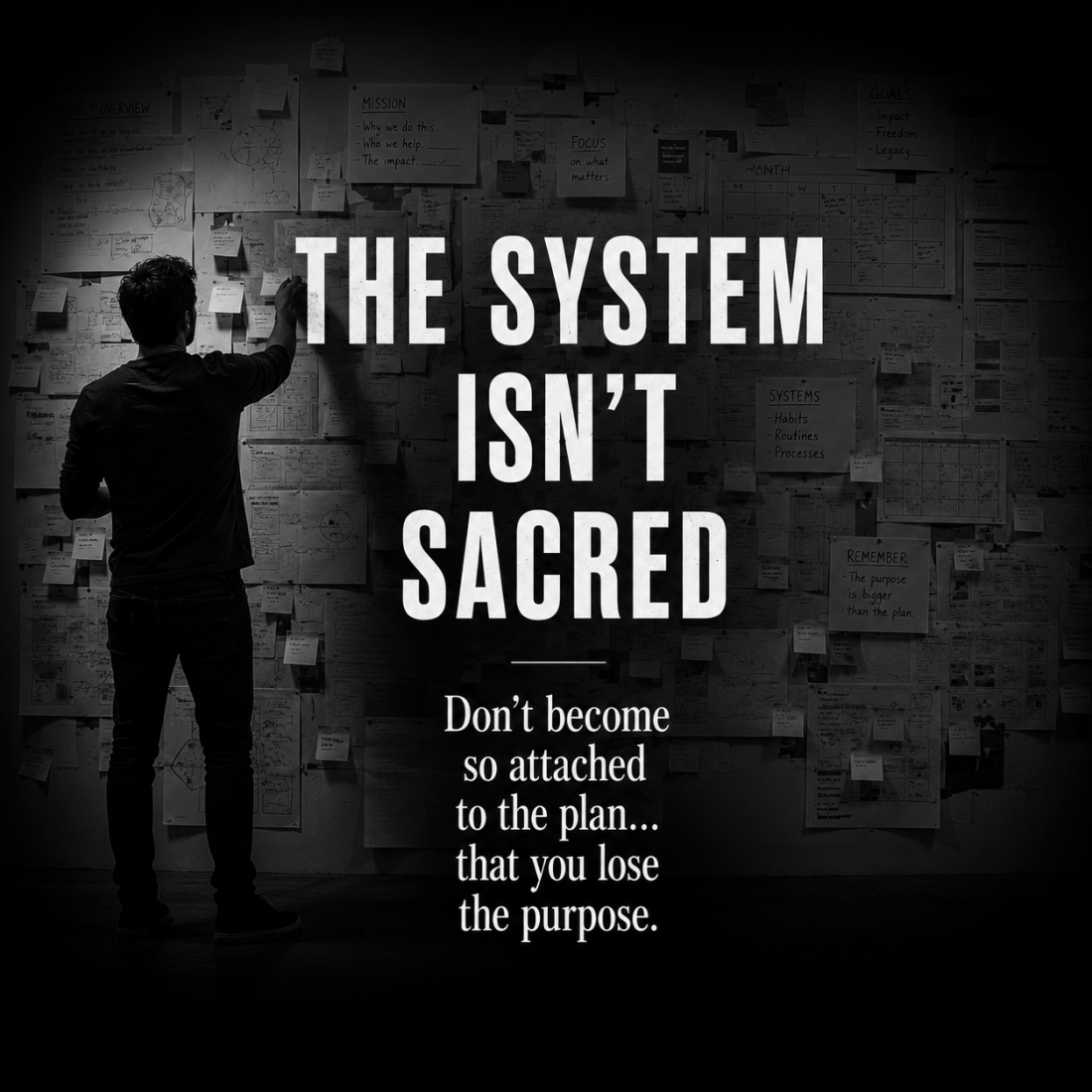
The system was never the project.

The scoreboards weren’t the project.

The trackers weren’t the project.

The spreadsheets weren’t the project.

Those things were simply tools meant to help me become the person I wanted to become.

And when the tools stopped serving that purpose…

They needed to change.

Six weeks ago I started this project with what I believed was the perfect blueprint.

Less than two months later, much of that blueprint no longer exists.

The dream does.

I chose the project over the systems.

I chose writing over documenting.

I chose to make room for my health instead of protecting routines that were no longer helping me.

For ten years I thought protecting the blueprint meant protecting the dream.

I finally realized they aren’t the same thing.

The blueprint can change.

The dream doesn’t have to.

Continue the Journey:

If you enjoyed this article, you may also like:

A Life, Not a Collection of Parts

It’s easy to divide life into separate categories—work, family, health, hobbies—but the most fulfilling life isn’t built by keeping those pieces apart. It’s built by learning how they fit together.

I Finally Stopped Waiting to Feel Motivated

Waiting for motivation kept me standing still for years. Progress finally began when I stopped chasing the perfect feeling and simply started doing the work.

The Coach Can’t Do the Work

The right tools, the right systems, and the right coach can all help you move forward. But in the end, no one else can do the work that only you can do.
The Coach Can’t Do The Work

I am going to be starting a personal training program in the next week or so, and yesterday I had my first call with my trainer. Being honest, I was nervous. I had never worked with a personal trainer before, but the conversation was great and also a little unexpected. Instead of just talking about exercises and nutrition, we talked about my goals, the habits I want to build, the mental aspect of getting healthier, my history with weight, and what I hope to achieve in the future.

As exciting as the call was, and as motivated as I am to work with this trainer, I’m still the one who has to put in the work. That’s something I’ve struggled with my whole life when it comes to my health.

The trainer can write my workouts, answer my questions, help keep me accountable, and encourage me when I’m frustrated. But he can’t lift the weights for me. He can’t choose what I eat every day. He can’t walk the steps I need to walk. He can’t say no to the junk food or turn off the TV so I can go work out. He can be a guide, but I still have to choose to follow.

I’ve done it before. In what feels like a past life, I lost 170 pounds. I was determined. I was resilient. Then I wasn’t. Some of the weight came back, and with it came frustration and disappointment.

Since then, I’ve read books about motivation and discipline. I’ve listened to podcasts. I’ve watched countless videos. I know what it takes to get back to where I want to be.

Information has never been the problem.

Turning that information into action has.

Often we think success comes from the tools we use along the way. The right pen or computer will help us write more. The right planner will keep us organized. The right app will keep us on task. Maybe the right coach will finally help us reach our goals.

Those things absolutely help.

They make the path clearer.

But they can’t walk it for us.

This project has never been about finally discovering the secret that erased years of failure. There isn’t one.

The progress I’ve made has come from doing the work day after day. From refusing to quit when things got hard. From not accepting defeat when I fell behind. From allowing the process to evolve instead of abandoning it because I was too stubborn to change.

The tools I’ve chosen have helped me get this far, but they aren’t the reason I’m here.

This trainer will be no different.

He gets to be on my team. He gets to challenge me, encourage me, and help me decide what I need to do to reach my goals.

But I still have to do the work.

The tools you use can help you write. They can help you stay organized. They can help you stay on task.

But if you don’t do the work, the tools can’t do it for you.

A coach, a trainer, or an accountability partner can all cheer you on. They can believe in you, even on the days you don’t believe in yourself.

But when it’s time to do the work…

You’re the one who has to do it.

And when you do, you’ll have something no one can ever take away from you:

The satisfaction of knowing you earned it.

Continue the Journey:

If you enjoyed this article, you may also like:

  • I Finally Stopped Waiting to Feel Motivated
    Motivation may get you started, but lasting change comes from taking action even when you don’t feel like it.
  • Stay in the Game
    Progress belongs to those who refuse to quit. Once you’ve committed to the journey, the work still has to be done one day at a time.
  • Every Opportunity Begins With Risk
    Hiring a coach, starting a new program, or chasing a goal all begin with uncertainty. The next step is doing the work that turns opportunity into progress.

Stay In The Game

Last night was poker night with the Papa Pandas. Ten of us showed up for a Texas Hold ‘Em tournament. On the opening hand I made two pair and won a large pot. Then I didn’t win another hand for a very long time.

Eventually the table had dwindled down to four players, and my dwindling stack was the smallest of them all. If you had taken a poll around the table, I probably wouldn’t have been the favorite to come out on top.

But I stayed patient. I played my game, bet when I thought the odds were in my favor, and took it one hand at a time. I eliminated one player, then another, and eventually it was just me and the chip leader. I won a couple of smaller pots to even things up before catching an outside straight on the river and moving all in. He called with two pair, and I walked away the winner.

I didn’t win because I played every hand perfectly. I folded hands that would have become winners and played a few that I probably shouldn’t have. I won because I stayed patient and stayed in the game. The cards certainly helped, but they couldn’t have helped me if I had already given up.

It made me wonder about all the other things I’ve quit simply because I got behind. How many times have I stopped writing because the words wouldn’t come? Quit exercising because the scale didn’t move? Walked away from a sport because I wasn’t getting playing time? Given up because things simply became too hard? Not because I was destined to fail, but because success didn’t seem likely, and I mistook where I was for where I was going to finish.

Yesterday I wrote that seizing opportunity requires us to accept uncertainty before we can enjoy the reward. Today I’m realizing that’s only half the story.

Sometimes taking the risk isn’t enough. Sometimes the reward only comes because we stay around long enough for it to arrive.

If you quit trying to lose weight every time the scale goes up or refuses to move, you’ll never reach your goal.

If you abandon every project because the results aren’t immediate, you’ll never finish anything meaningful.

If you give up on every dream because reality doesn’t match the picture in your head, you’ll never become the person you hoped to be.

It won’t be because you weren’t talented enough or capable of working hard enough. It’ll be because you didn’t give yourself—or your dream—the time it needed.

Last night I happened to win the poker tournament. But that’s not what I’ll remember.

I’ll remember looking down at the smallest stack at the table and realizing that as long as I still had chips in front of me, the story wasn’t over.

Sometimes the only thing you can do is stay in the game long enough to find out how the story ends.

Continue the Journey:

If you enjoyed this article, you may also like:

They Don’t Have To Understand

Today’s post is built around a quote that I recently came across:

“Protect your peace and your vision because not everyone will understand either.”

This one had me thinking because it resonated with where I am in this project.

Not because I’m receiving criticism or doubt for what I’m trying to accomplish…

But because I’m not hearing anything at all.

This may come as a surprise, but I can count the number of people I know personally who truly know about The Young Napoleon Project on one hand.

I’m intentionally quiet about what I’m doing here.

My wife, my parents, and a few select others know that I’m writing a book and that I have this blog. A few more know about the work I’m putting into getting healthier.

But that’s about it.

No one really knows what The Young Napoleon Project truly is because I’ve been hesitant to actually talk about it.

This project didn’t start last month.

As of writing this, I’m technically on Day (43), but I stopped counting the number of times I’ve launched this project and never made it to Day (43).

I first had the idea for this project well over a decade ago—before I got married, before I bought a house, before I had kids.

People who see this project today are seeing the latest, and hopefully greatest, iteration of it.

What they don’t see are the countless restarts along the way.

The abandoned notebooks.

The unfinished brainstorming sessions.

The ideas that never made it past the first page.

The quiet hope that every restart would finally become the one that lasted.

They see pieces of my story, but I’ve lived the entire tale.

Maybe that’s why this project means so much to me and looks so ordinary to everyone else.

And yet, despite rarely sharing my “why,” I still catch myself expecting people to understand it.

But how could they?

They haven’t been inside my head to experience the defeats and frustrations.

They haven’t felt the anxiety that comes with starting over or the joy that comes with believing this time might be different.

They haven’t carried this dream with them for over a decade while wondering if it would ever become reality.

They haven’t fought the emotional battles I’ve fought over my own shortcomings or experienced the mental fatigue that repeated failure can bring.

It’s unreasonable to expect someone to understand where I’m coming from when I’ve never really shown them where that is.

And that’s not just true for me.

We all carry dreams.

Maybe yours is to lose weight.

Start a business.

Go back to school.

Change careers.

Run a marathon.

Build a family.

When people look at you, they see what you’re doing today.

They don’t see everything that led up to this moment.

They don’t see the struggle.

They haven’t watched you fight.

They only see one chapter of a story you’ve been living for years.

Here’s the thing:

People don’t need to understand your dream or your vision for it to be worth pursuing.

You don’t need their approval.

You don’t need their recognition.

Because your dream is incredibly personal to you.

It doesn’t have to be a secret.

You can tell everyone about it if you want.

But you can’t expect them to spend every day in the trenches of a battle they’re not fighting.

People can support you.

They can encourage you.

They can cheer you on.

And they can do all of that without fully understanding your why.

While thinking about this, I found myself coming back to Simon Sinek’s TED Talk, Start With Why. He argues that our “why” is what gives our actions meaning. We often think our “why” exists so we can explain ourselves to other people, but maybe its more important purpose is reminding us why we started when no one else fully understands what we’re building.

I also came across this essay from A Life of Lovely about why we don’t always need to explain ourselves to everyone else. It made a point that resonated with me: not every dream needs to be defended or fully understood by other people to be worth pursuing. Sometimes the people who matter most can support us without fully understanding what we’re carrying.

You are the only one who has to know your why.

You are the only one who can’t give up on yourself.

For me, this project isn’t just a blog.

It isn’t just a book I’m writing.

It isn’t just losing weight.

It’s my attempt to build my life intentionally. Part of that has meant accepting that I’ll probably never finish this project, something I explored in The Myth Of Falling Behind

It’s also my attempt to accomplish something I first set out to do over a decade ago and am still fighting to achieve today. Ironically, the dream itself has changed over those ten years, something I wrote about in Every Season Has Different Dreams. The destination evolved, but the desire to build a meaningful life never did.

No one will ever understand why it matters to me as deeply as I do.

And that’s okay.

Maybe someday people will understand why this mattered so much to me.

Maybe they won’t.

The same goes for your dream.

Either way, we both have to keep going.

We have to wake up tomorrow and take the next step toward our dreams and our vision.

Because that’s what matters to us.

And no one else has to understand that.

Continue the Journey:

Further Reading:

Simon Sinek — Start With Why (TED Talk)

https://youtu.be/u4ZoJKF_VuA?is=O32TQ6Jl0PQmJfpl

A Life of Lovely — Why You Don’t Need to Explain Yourself to Anyone

https://alifeoflovely.com/why-you-dont-need-to-explain-yourself-to-anyone/#google_vignette